Corinaldo
Brick ramparts, a theatrical staircase and stories around every corner.
Corinaldo sits above the cultivated hills inland from Senigallia. Its fortified outline is the first attraction, but step through a gate and the scale becomes intimate: lanes, small squares, a celebrated well and art gathered from the town’s churches. Come for a slow walk, and leave room for the interiors.
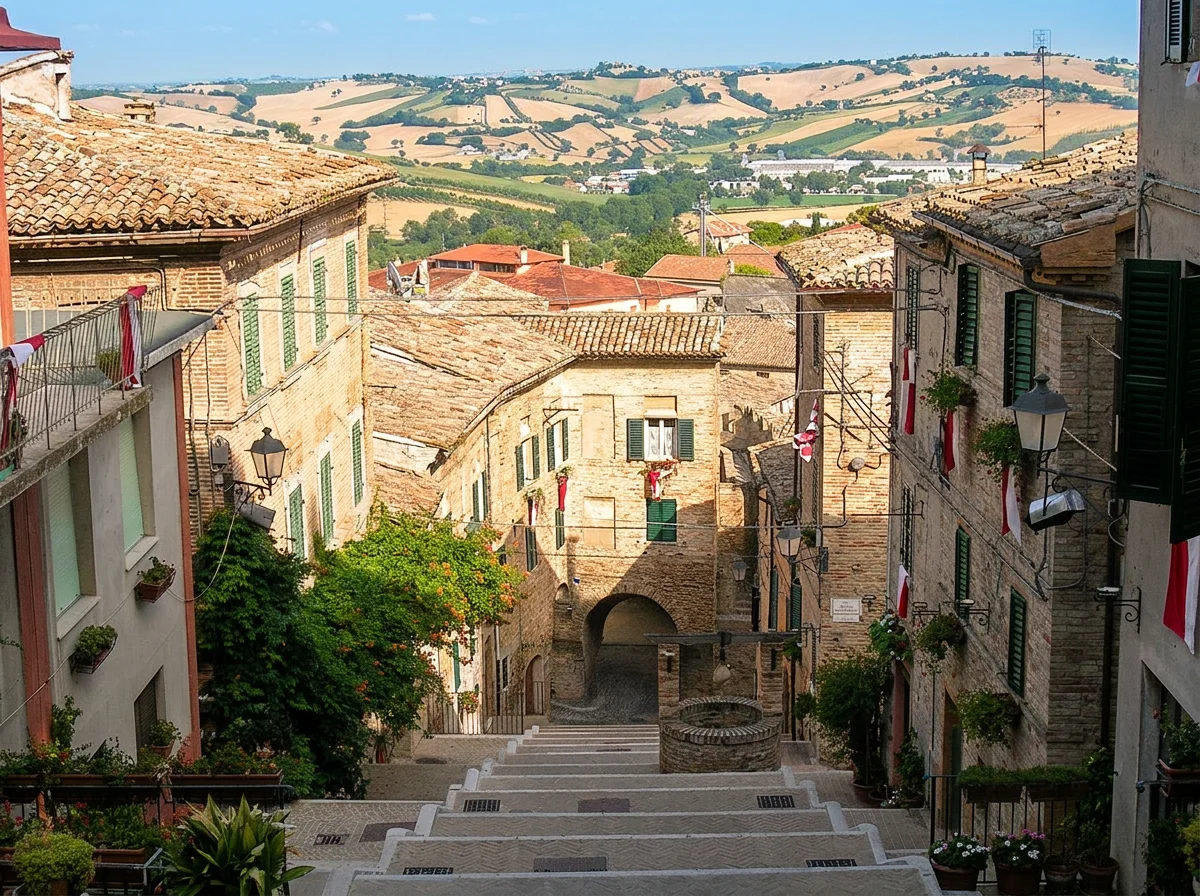
01 · WALLS & TOWERS
Follow the outline of a fortified town
Corinaldo’s surviving walls encircle the historic centre for roughly a kilometre. Medieval defences and later Renaissance additions come together in a sequence of gates, towers and projecting bastions, with the town rising behind them.
Begin outside the walls to understand their shape, then enter through a historic gateway and explore the lanes within. The changing viewpoints are part of the pleasure: close-up brickwork gives way to open views across the agricultural landscape.
The official historic itinerary connects landmarks including Porta San Giovanni, the Scorticatore tower, Porta Santa Maria del Mercato and the Rotonda. Follow signed public routes and use wall walks only where access is open.
Hidden Italy tip: Make your first circuit before choosing a café. It helps you understand the different levels of the town and decide which climbs you want to save for later.
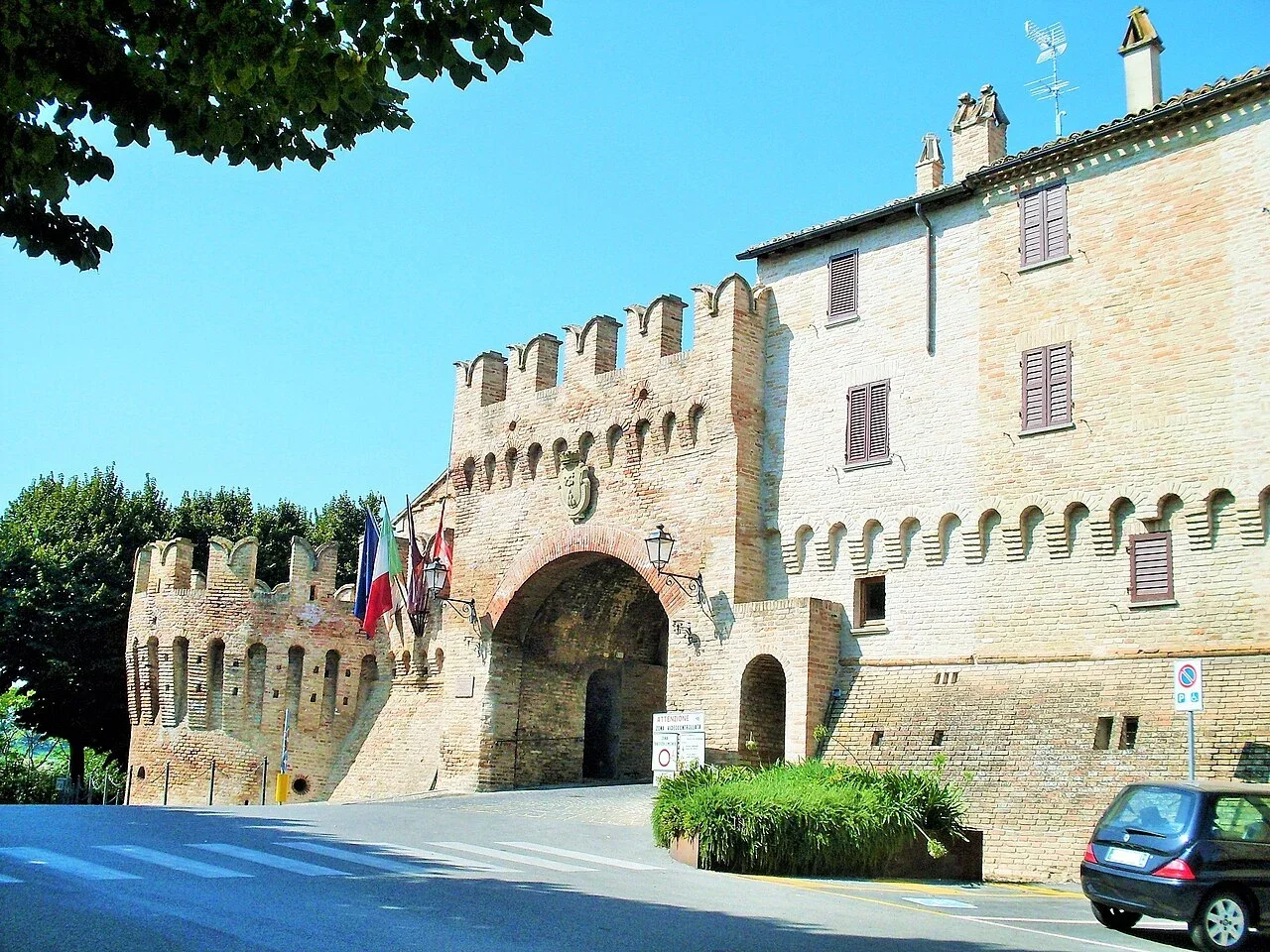
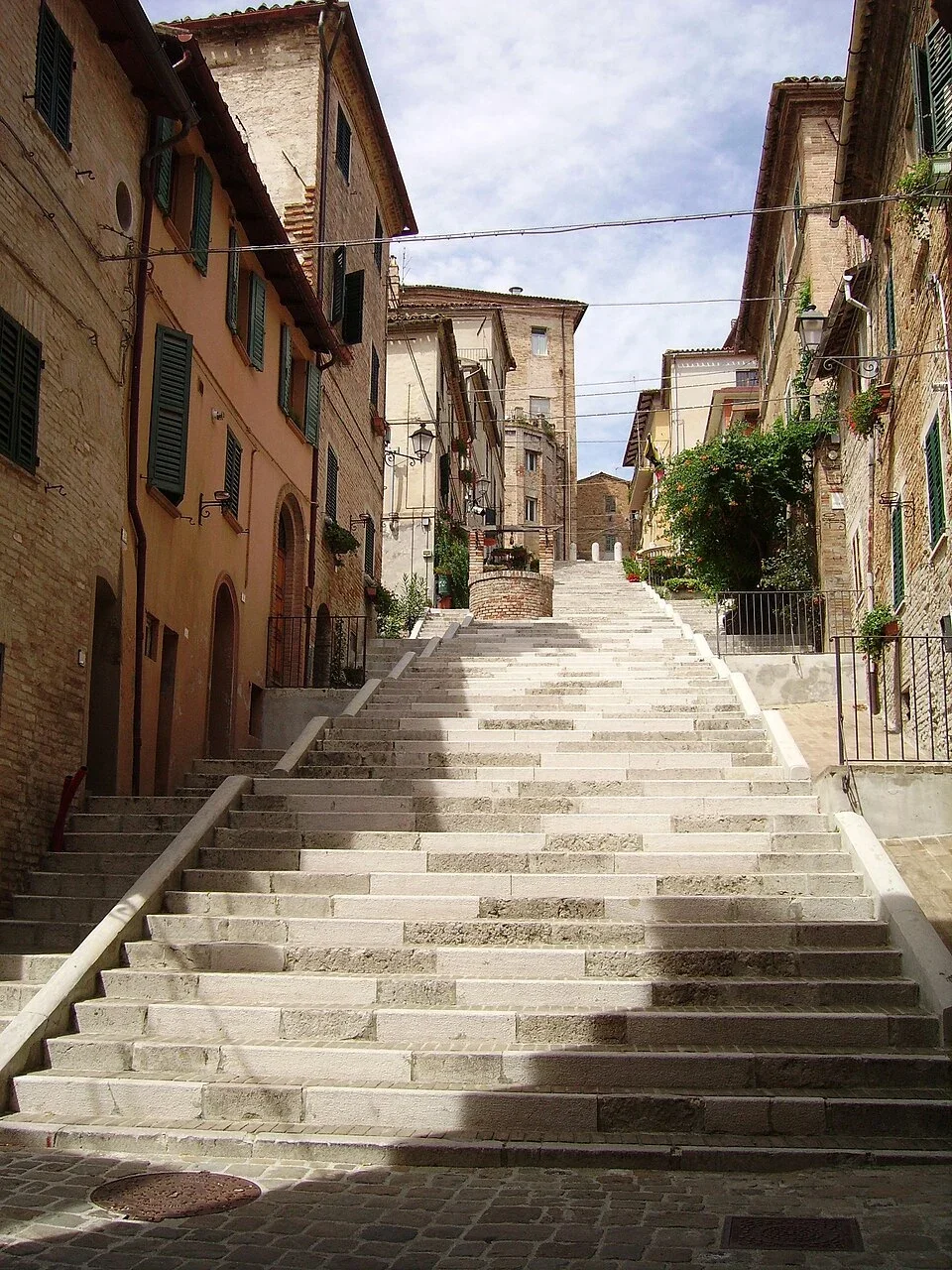
02 · LA PIAGGIA & THE POLENTA WELL
A staircase that becomes a little stage
La Piaggia is Corinaldo’s signature street: a long flight of steps framed by brick houses, with the Pozzo della Polenta interrupting the climb. Look uphill from below, then pause partway up to see the street unfold in the other direction.
The well carries a story older than the structure you see today. A well was created here in the fifteenth century; after it was filled in during the early twentieth century, the present landmark was reconstructed in 1980 in connection with the town’s historical festivities.
It is a good place to notice how daily life, local storytelling and architectural preservation overlap. The staircase makes a memorable photograph, but the side lanes reward a few extra turns away from the main view.
Plan ahead: La Piaggia is a stepped route. If stairs are difficult, ask the tourist office for its accessible itinerary instead of treating the staircase as the only way to explore.
03 · ART & THEATRE
Look behind the brick façades
The Claudio Ridolfi Civic Art Collection occupies part of the former Augustinian convent. Its religious paintings and objects preserve work from local churches, including carved and painted wooden reliquaries and a seventeenth-century silver processional cross.
This is a useful counterpoint to the defensive architecture outside: it reveals the devotional and artistic life of the community. Look for works by Ridolfi and other artists connected with the region rather than rushing through for one famous name.
The nineteenth-century Carlo Goldoni Theatre adds another layer of civic life. Its restored interior is part of Corinaldo’s cultural circuit, but visits depend on the current opening programme.
Hidden Italy tip: Check the Luoghi della Cultura visitor information before travelling. The theatre and collections are not necessarily open whenever the streets are accessible.

PLAN YOUR VISIT
Give Corinaldo time beyond the photograph
A suggested half day or slow full day
Morning: start with a circuit of the walls and gates, then enter the centre and walk towards La Piaggia. Pause for coffee before exploring the smaller lanes. This outdoor route makes a comfortable focus for a half-day visit if you keep the climbs unhurried.
Afternoon: if the cultural sites are open, add the Ridolfi collection and a theatre visit, with lunch between them. We suggest a full day when you want several interiors; check admission arrangements first and adjust the order around them.
Where to stay & how long to spend
A night in the village lets you enjoy the streets after day visitors leave. Countryside accommodation suits a driving trip through the surrounding hills, while a coastal base near Senigallia offers a different balance of beach and inland visits. Ask about parking, luggage access and stairs before choosing a room in the old centre.
When to visit
Spring and autumn are our preferred seasons for walking the walls and countryside. In summer, aim for cooler morning or evening hours. If you want to attend a festival or performance, consult the current town calendar rather than assuming an annual event keeps the same dates.
Arrival & getting around
A car is useful for combining Corinaldo with other hill towns. Use signed parking outside the historic streets and continue on foot. For a public-transport visit, check the inland connection and return service from the coast before setting off.
The centre includes slopes, steps and uneven surfaces. Corinaldo Tourism publishes an accessible itinerary; use it as a starting point and confirm the entrances of any museum you plan to visit.
Build it into a longer Marche trip
Balance Corinaldo’s fortified streets with a coastal day or another inland town, allowing time for the journeys between them. Find regional stops in our Le Marche travel guide.
For official routes and local information, see Corinaldo Tourism’s itineraries and the current cultural-site arrangements.
Image credits
Town gate: Porta Nuova Corinaldo by Claudio.stanco, CC BY-SA 4.0, via Wikimedia Commons.

La Piaggia: Corinaldo - La scalinata by Beta16, CC BY-SA 3.0 Italy, via Wikimedia Commons.

Museum exhibit: Civica raccolta d'arte "Claudio Ridolfi" - Il Principe di Corinaldo 8 by Accurimbono, CC BY-SA 4.0, via Wikimedia Commons.

Commons images converted to WebP and resized for this page. Adapted versions remain available under the respective licences linked above.